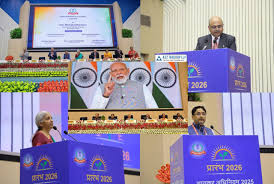
PRARAMBH 2026 New Era of Citizen-Centric Taxation in India
PRARAMBH 2026
New Era of Citizen-Centric Taxation in India
The landscape of Indian fiscal administration is on the brink of a historic transformation. As the nation marches toward the vision of "Viksit Bharat" (Developed India) by 2047, the traditional frameworks of revenue collection are being replaced by more agile, transparent, and technology-driven systems. In preparation for the enforcement of the landmark Income Tax Act, 2025, which is slated to take effect on April 1, 2026, the Government of India has unveiled a comprehensive nationwide awareness initiative titled PRARAMBH 2026. This campaign is not merely a public relations exercise; it is a fundamental shift in how the state interacts with its taxpayers. By moving away from an adversarial "policing" model toward a "service-oriented" philosophy, PRARAMBH 2026 aims to demystify complex legislation and foster a culture of voluntary compliance.
The Genesis and Mandate of PRARAMBH 2026
PRARAMBH, an acronym for Policy Reform and Responsible Action for Mission Viksit Bharat, serves as the vital bridge between the legislative intent of the new Income Tax Act and the ground-level reality of the common citizen. This campaign is structured to address the systemic "compliance fatigue" that has often plagued the Indian tax ecosystem. The initiative is spearheaded by a dual-layered administrative structure. At the helm is the Ministry of Finance (Department of Revenue), acting as the nodal authority responsible for the broad policy architecture and strategic oversight of the transition. Complementing this is the Central Board of Direct Taxes (CBDT), the apex body for direct tax administration, which is tasked with the on-ground execution of the outreach programs. Together, these entities are working to ensure that the transition to the 2025 Act is seen as a modernization milestone that benefits every stakeholder in the Indian economy.
Bridging the Knowledge Gap: Core Objectives
The primary hurdle in any tax reform is the "fear of the unknown." Historically, tax laws in India have been perceived as dense, intimidating, and prone to litigation. PRARAMBH 2026 addresses this by setting clear, mission-oriented objectives. The first is Seamless Adaptation. By providing a long lead time before the Act becomes official, the government is allowing taxpayers, chartered accountants, and legal professionals to familiarize themselves with the new rules. This prevents the "last-minute panic" that typically accompanies major legislative shifts. Secondly, the campaign seeks to establish Trust-Based Taxation. In a democratic setup, revenue collection thrives when citizens believe the system is fair and logical. By increasing awareness, the government hopes to reduce inadvertent errors, which are often mistaken for evasion thereby encouraging honest reporting. Finally, Administrative Clarity is a top priority. The initiative focuses on simplifying terminology and procedural requirements to minimize disputes and reduce the massive backlog of cases currently clogging the appellate tribunals.
Technological Integration: Kar Saathi and Website 2.0
In the age of the Fourth Industrial Revolution, PRARAMBH 2026 leverages cutting-edge technology to make taxation accessible to every smartphone user. One of the standout features of this campaign is the introduction of 'Kar Saathi', an advanced AI-driven chatbot. Kar Saathi is designed to provide instantaneous, 24/7 assistance to taxpayers, answering queries ranging from basic filing procedures to complex interpretations of the new Act. This effectively democratizes access to tax expertise, reducing the friction of having to visit physical tax offices or wait on hold for call centers. Furthermore, the government has launched Income Tax Website 2.0. This revamped portal is a massive leap forward in user experience, offering intuitive navigation, faster load times, and a dashboard that gives users a holistic view of their tax history, deductions, and current liabilities. These digital tools ensure that the "faceless assessment" regime is supported by a "helpful face" of technology, making the process of filing returns as easy as online shopping.
Inclusivity Through Multilingual and Physical Outreach
India’s vast socio-economic diversity presents a unique challenge for any nationwide campaign. Recognizing that English and Hindi may not reach every corner of the country, PRARAMBH 2026 has adopted a robust Multilingual Communication strategy. Information about the Income Tax Act, 2025, is being disseminated in all 22 scheduled languages to ensure that linguistic barriers do not lead to non-compliance. Moreover, while the push for digital transformation is strong, the government has not abandoned those on the other side of the digital divide. The Aaykar Seva Kendras (ASK) have been revitalized to serve as high-tech physical help centers. These centers provide hand-holding support to senior citizens, small-scale entrepreneurs, and individuals in rural areas who may lack stable internet access or digital literacy. By combining digital "Kar Saathi" with physical "Aaykar Seva Kendras," the government is ensuring that the tax reform is truly inclusive, leaving no citizen behind in the transition to a modernized economy.
Capacity Building: Training the Facilitators
A reform is only as good as the people who implement it on the ground. A significant portion of PRARAMBH 2026 is dedicated to Capacity Building for thousands of tax officials across the country. Nationwide workshops are being conducted to retrain the workforce of the Income Tax Department, moving them away from the "Search and Seize" mindset of the past. These sessions focus on the technical nuances of the 2025 Act and, more importantly, on a behavioral shift toward professional service. Officials are being trained to act as "facilitators" rather than "inspectors." This uniform training ensures that a taxpayer in a small district in Uttar Pradesh receives the same quality of guidance and interpretation as a corporate entity in Mumbai. By aligning the internal machinery of the CBDT with the goals of the PRARAMBH campaign, the government is creating a cohesive ecosystem where the administrator and the taxpayer are partners in national building.
The Philosophy of ‘Nagrik Devo Bhava’ and Global Significance
At its heart, PRARAMBH 2026 is an embodiment of the philosophy "Nagrik Devo Bhava" (The Citizen is God). This represents a paradigm shift in Indian governance where the convenience, dignity, and time of the taxpayer are prioritized. By simplifying the tax code and removing ambiguous clauses that lead to unnecessary harassment, the government is signaling a high level of trust in its citizens. The significance of this move extends beyond India’s borders. As India positions itself as a global investment destination and a hub for Global Capability Centres (GCCs), a stable, predictable, and citizen-friendly tax regime is a prerequisite. PRARAMBH 2026 serves as an assurance to both domestic and international investors that India is committed to the "Ease of Doing Business" and is moving toward a non-adversarial tax environment. This transparent approach reduces the "tax risk" for multinational corporations, thereby attracting more foreign direct investment (FDI) into the country.
Conclusion: A Foundation for Viksit Bharat
As the countdown to April 1, 2026, begins, PRARAMBH 2026 stands as a testament to India’s maturing fiscal policy. It is more than just a logistical preparation for a new law; it is a movement to redefine the social contract between the state and the people. By integrating AI tools like Kar Saathi, providing multilingual support, and focusing on trust-based compliance, the campaign removes the traditional dread associated with "tax season." Through these efforts, the government is not just collecting revenue; it is building the financial foundation of a developed nation. PRARAMBH 2026 ensures that when the Income Tax Act, 2025, finally takes effect, the citizens of India will be ready to contribute to the nation's growth with clarity, confidence, and pride. The success of this campaign will be measured not just in the quantity of tax collected, but in the quality of the relationship between the Indian state and its primary stakeholders, the taxpayers.