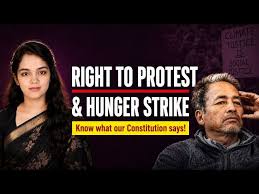
Constitutional Legality of Hunger Strikes in India
Constitutional Legality of Hunger Strikes in India
The intersection of state authority and individual conscience frequently manifests in the act of political fasting. In the landscape of Indian governance, the legal status of the hunger strike occupies a unique space where the boundaries of civil liberties, statutory boundaries, and the executive's duty of care continuously collide. Indian courts have consistently wrestled with a profound constitutional paradox: how to honor the state's paternalistic obligation to preserve human life while simultaneously protecting the sacred right to peaceful, non-violent political dissent.
As administrative frameworks evolve, the judicial understanding of prolonged fasting has shifted from treating the act as a criminal violation to recognizing it as a protected vehicle of democratic expression. This transformation requires a delicate balance. The state must prevent the weaponization of its policing powers to crush legitimate dissent, even as it navigates its fundamental obligation to prevent preventable deaths within its jurisdiction.
1. Historical Resonances and the Socio-Political Context of Political Fasting
The employment of a hunger strike as a primary mechanism of political leverage is deeply woven into the historical fabric of the Indian sub-continent. Far from being a modern disruptive tactic, prolonged self-abnegation holds immense moral authority, having been codified as a legitimate weapon of non-violent resistance during the freedom struggle. Satyagraha, as articulated and practiced by Mahatma Gandhi, elevated the act of fasting from a mere physical protest to a potent tool of ethical and political suasion capable of shifting state policy.
In the post-independence era, this legacy has been continuously invoked by civil rights crusaders and anti-corruption activists to challenge institutional inertia. The decade-long agitations led by figures such as Irom Sharmila in the Northeast, or the public anti-graft campaigns mobilized by Anna Hazare, demonstrate that fasting remains an active, relevant phenomenon in contemporary public life. Consequently, contemporary judicial interventions do not view hunger strikes in a vacuum; instead, they analyze them as historically grounded expressions of civil disobedience that require careful accommodation within a democratic legal framework rather than outright criminal suppression.
2. Decoupling Self-Harm from Dissent: The Transition to the Bharatiya Nyaya Sanhita
For decades, the primary legal weapon utilized by the state against individuals undertaking hunger strikes was Section 309 of the colonial-era Indian Penal Code (IPC). This statutory provision criminalized the attempt to commit suicide, effectively classifying any prolonged, health-threatening political fast as a penal offense. Law enforcement agencies routinely deployed Section 309 to arrest protestors, place them under judicial detention, and subject them to involuntary medical intervention. Critics long argued that this approach conflated severe psychological despair with deliberate, high-minded political statements, turning a human rights issue into a law-and-order crisis.
The landscape transformed fundamentally with the introduction of the Bharatiya Nyaya Sanhita (BNS), which sought to rationalize and modernize the country's penal code. Under Section 226 of the BNS, the blanket criminalization of self-harm was substantially narrowed. The modern legal framework establishes a high threshold for state intervention, declaring that a suicide attempt is only punishable if it is explicitly designed to coerce, restrain, or obstruct a public servant from discharging their official, legally mandated duties. This statutory shift explicitly decriminalizes the act of fasting born out of political or social conviction, provided it does not cross the line into aggressive state obstruction.
3. The Constitutional Anchor: Article 19 and the Architecture of Peaceful Assembly
The legal legitimacy of a hunger strike does not merely rely on the absence of a prohibitive criminal law; it is positively anchored within the fundamental rights guaranteed by the Constitution of India. Specifically, Article 19(1)(b) secures for all citizens the right to assemble peacefully and without arms. This provision serves as the structural foundation for all forms of non-violent democratic mobilization, including dharnas, public rallies, and organized fasts. The judiciary has repeatedly affirmed that the freedom to protest is an unalienable feature of a functional democracy, allowing marginalized or aggrieved groups to draw public attention to systemic failures.
However, this constitutional protection is not absolute. Under the restrictive clauses built into the constitutional text, the state retains the authority to impose reasonable restrictions on the exercise of these rights. These restrictions can be activated exclusively on specific, narrow grounds, primarily the maintenance of public order, the preservation of national sovereignty, and the protection of the territorial integrity of India. Therefore, while a hunger strike is recognized as a valid form of peaceful assembly, its constitutional immunity persists only as long as the protest remains non-violent and does not threaten the broader stability of civil society.
4. The Shift from Penalization to Qualified Right to Dissent
The evolution of Indian jurisprudence on hunger strikes reveals a clear transition from an authoritarian, penalizing stance to a more nuanced, rights-respecting approach. In earlier decades, the state's response to long-term fasting was heavily reliant on force-feeding and immediate incarceration. The legal system viewed the absolute preservation of physical life as paramount, even if it meant overriding the bodily autonomy and political expression of the individual. This older perspective treated the hunger striker as an existential threat to administrative stability and an individual engaging in unlawful self-destruction.
In contrast, modern judicial philosophy draws a sharp line between acts of self-harm arising from personal distress and public fasts undertaken as a matter of conscious political protest. The current approach prioritizes individual autonomy, viewing the hunger strike as an ultimate, peaceful appeal to the conscience of the state. By acknowledging that a political fast is a communicative act rather than an act of violence, the courts have significantly limited the executive's power to treat peaceful protestors as common criminals, thereby widening the zone of protected democratic dissent.
5. Ambiguities, Coercion, and the Dilemma of Forced Medical Intervention
Despite these progressive strides, significant operational and ethical challenges persist at the ground level. A primary concern is the inherent textual ambiguity residing within Section 226 of the BNS. Determining whether a hunger strike constitutes a peaceful democratic appeal or an unlawful, coercive attempt to "compel a public servant" remains highly subjective. This gray area leaves substantial discretionary power in the hands of local law enforcement officials, who may still choose to interpret a high-profile fast as a criminal attempt to paralyze administrative operations, leading to arbitrary arrests.
Furthermore, the conflict between an individual’s right to refuse medical treatment as a form of protest and the state’s paternalistic duty to preserve life creates profound legal and ethical dilemmas. When a protestor’s health deteriorates to a critical point, the state is often forced to choose between respecting the individual’s bodily autonomy and executing its duty to prevent loss of life. The resulting recourse to clinical force-feeding is frequently criticized by human rights advocates as a violation of human dignity, yet it is defended by administrators as a necessary measure to prevent martyrdom from igniting wider public disorder.
6. Structural Mechanisms for Institutional Dialogue and Harm Reduction
To resolve these systemic frictions, India must transition away from a reactive, security-centric approach toward an institutionalized system of conflict resolution. First, it is essential to formulate clear, standardized operating guidelines for law enforcement agencies across all jurisdictions. These guidelines must explicitly define the parameters of Section 226 of the BNS, ensuring that the statute is never weaponized to dismantle peaceful agitations or silence critics who use fasting to highlight legitimate grievances.
Second, the administrative response to a hunger strike must shift from a penal framework to a humanitarian and medical model. When an individual commences a fast, the state's immediate priority should be the provision of independent medical surveillance, counseling, and open communication channels, rather than the deployment of police forces. Finally, the state must establish permanent, transparent institutional mechanisms for timely mediation. By proactively engaging with protestors and addressing the root causes of their grievances at an early stage, the administration can prevent the escalations that transform peaceful fasts into dangerous health crises.
Conclusion
Ultimately, the legal paradigm governing hunger strikes in India serves as a crucial test for the health of its democracy. The modern legal framework, enhanced by recent legislative reforms, correctly distances itself from the archaic penalization of political fasting, opting instead to safeguard the fundamental right to non-violent expression. By balancing the sovereign obligation to preserve human life with a profound respect for constitutional freedoms, the legal system ensures that state interventions remain proportionate, humane, and fundamentally aligned with democratic values.