
Sudden Stratospheric Warming (SSW) Event
09.12.2025
Sudden Stratospheric Warming (SSW) Event
Context
Meteorologists have issued warnings regarding a potential Sudden Stratospheric Warming (SSW) event in December 2025. This phenomenon threatens to disrupt the polar vortex, potentially funneling unusually frigid Arctic air into parts of the United States.
About Sudden Stratospheric Warming (SSW) Definition:
- What it is: An SSW is a weather phenomenon characterized by a rapid temperature rise, sometimes jumping by up to 50°C, within the stratosphere (approximately 10–50 km above Earth's surface).
- Primary Effect: It destabilizes the polar vortex, the band of strong westerly winds that typically circles the Arctic, often leading to significant weather anomalies at ground level.
Mechanism: How it Occurs
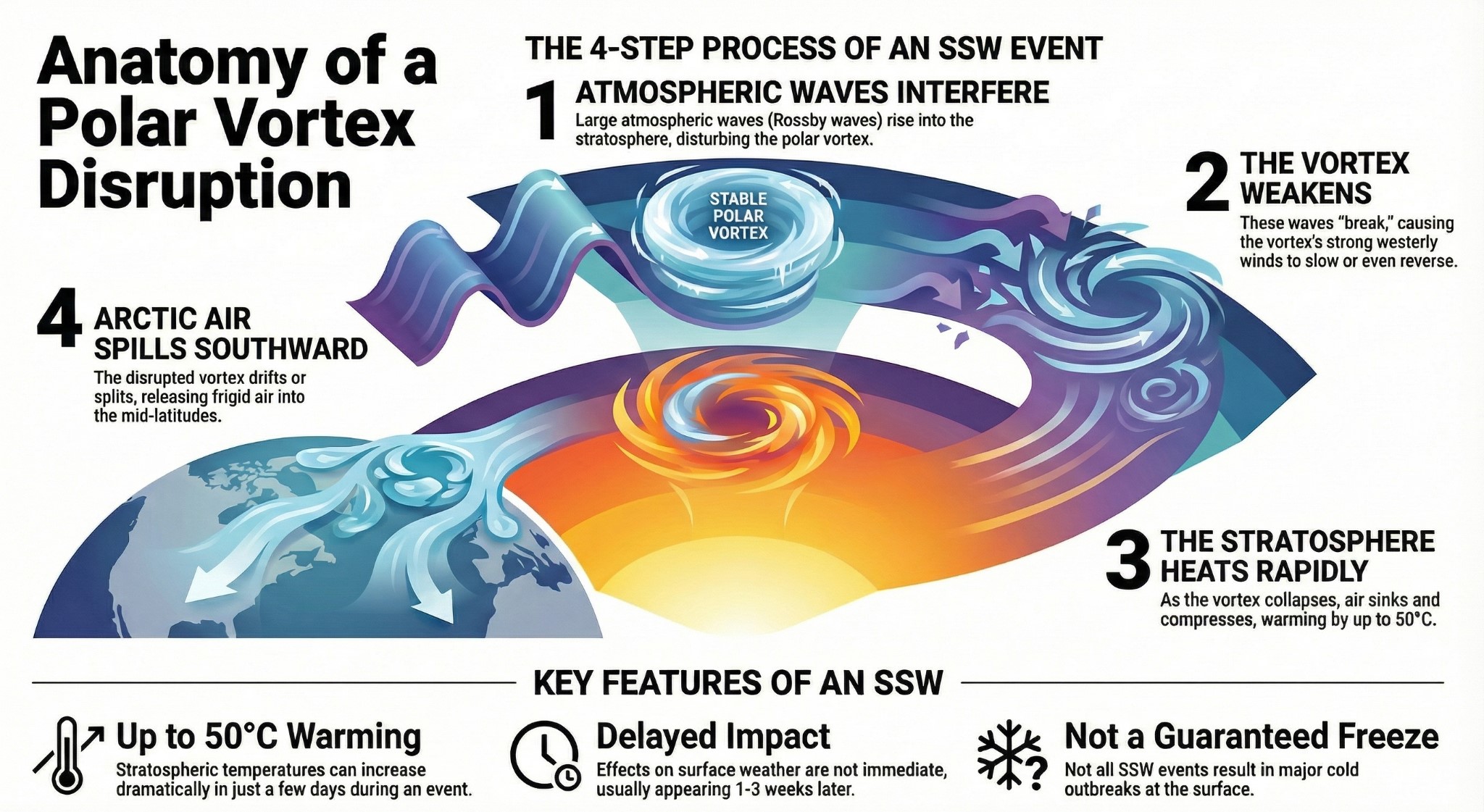
- Polar Vortex Formation: During winter, strong westerly winds tighten around the Arctic, creating a "stratospheric polar vortex" that effectively traps freezing air high above the pole.
- Interference by Rossby Waves: Large atmospheric disturbances known as Rossby waves rise from the lower atmosphere (troposphere) into the stratosphere, transferring energy that disturbs the vortex's stability.
- Wave Breaking: Similar to ocean waves crashing, these atmospheric waves "break" against the vortex. This can weaken or even reverse the direction of the westerly winds, throwing the polar wind system into chaos.
- Rapid Compression & Warming: As the weakened system collapses, cold stratospheric air descends rapidly. As it sinks, it compresses and heats up intensely—causing the sudden temperature spike that defines the event.
- Displacement: The disrupted vortex may split or drift southward, allowing trapped Arctic air to spill into mid-latitudes, triggering cold outbreaks in North America, Europe, or Asia.
Key Features
- Drastic Warming: Stratospheric temperatures can increase by up to 50°C in just a few days.
- Wind Reversal: The typical westerly winds often slow down or reverse to become easterlies.
- Lag Effect: The impact on surface weather is not immediate; effects usually manifest 1–3 weeks after the stratospheric event.
- Irregularity: SSW events do not occur every winter, and not every event guarantees a major impact on surface weather.
Implications Weather Impacts:
- Cold Snaps: Can unleash sudden, severe cold waves, snowstorms, and prolonged freezing conditions across North America and Europe.
- Atmospheric Blocking: May alter storm tracks and establish high-pressure "blocks" over the North Atlantic, leading to stagnant weather patterns.
Forecasting Challenges:
- Predictability: Accurate predictions are difficult beyond a 7–10 day window.
- Uncertainty: Meteorological models often struggle to pinpoint exactly where the displaced pocket of Arctic air will land.
Conclusion
While Sudden Stratospheric Warming originates high in the atmosphere, its potential to reverse wind patterns and displace polar air makes it a critical driver of severe winter weather in the Northern Hemisphere. Monitoring these events is essential for preparing for potential cold air outbreaks in mid-latitude regions.