
Senna spectabilis
10.12.2025
Senna spectabilis
Context
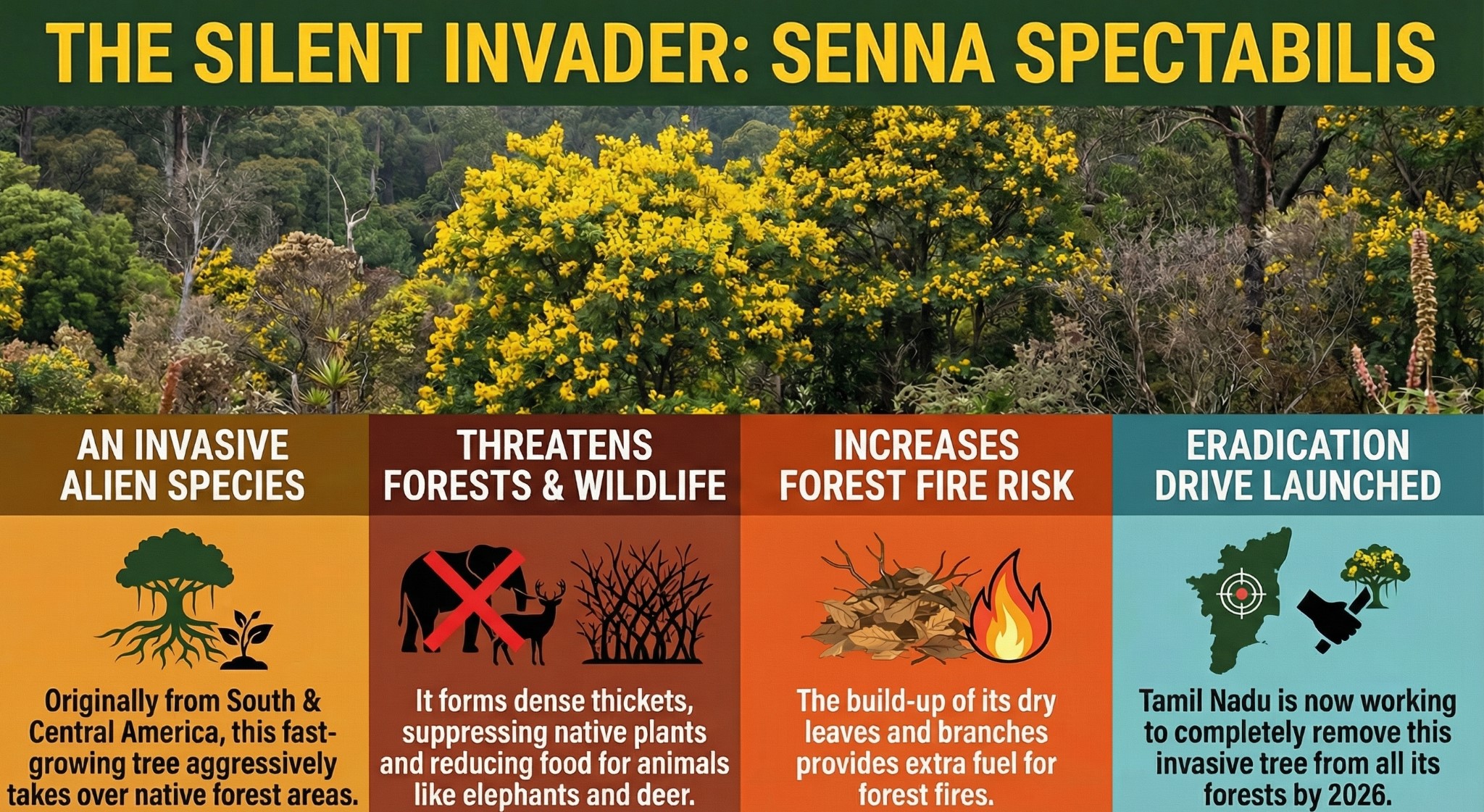
Tamil Nadu has launched one of India’s largest invasive-species eradication drives, targeting the complete removal of Senna spectabilis from all forest divisions by March 2026.
About Senna spectabilis
Definition:Senna spectabilis is a fast-growing, yellow-flowering tree belonging to the legume family (Fabaceae). While widely planted as an ornamental and shade tree, it is now recognized as a highly invasive alien species in India, Africa, and parts of Asia.
Origin & Distribution:
- Native to: South & Central America (Brazil, Argentina, Paraguay, Bolivia, Peru, Venezuela).
- In India: It has aggressively invaded ecosystems in the Nilgiris, Mudumalai, Sathyamangalam, Anaikatty, and other parts of the Western Ghats.
Habitat:
- Thrives in dry to moist deciduous forests, disturbed woodlands, savannahs, and well-drained soils.
- Prefers full sunlight, adapts well to poor soils, and spreads easily through prolific seed production.
Key Characteristics
- Growth: Grows 7–18 m tall, developing a dense, spreading crown that forms thick canopies.
- Appearance: Features bright yellow flowers and long dehiscent pods (15–30 cm) containing numerous hard-coated seeds.
- Behavior: Leaves exhibit nyctinasty (they close at night and open at dawn).
- Traditional Uses: Used for fuelwood, ornamental planting, shade, and making small implements.
- IUCN Status: Classified as Least Concern.
Ecological Implications
- Biodiversity Threat: It suppresses native vegetation by forming dense monocultures, effectively reducing overall forest biodiversity.
- Wildlife Impact: The tree limits fodder availability for herbivores like elephants and deer, which can alter wildlife movement patterns.
- Fire Risk: The accumulation of dry biomass raises the risk of forest fires.
- Regeneration Issues: It delays natural forest regeneration, threatening the long-term resilience of the ecosystem.
Conclusion
The aggressive spread of Senna spectabilis poses a significant threat to the biodiversity and stability of India's forest ecosystems. Tamil Nadu's eradication drive represents a critical step in restoring the ecological balance of the Western Ghats.