
Dadabhai Naoroji
09.12.2025
Dadabhai Naoroji
Context
In 2025, India commemorates the 200th birth anniversary of Dadabhai Naoroji. The celebrations honor his enduring legacy as a pioneering nationalist leader, a profound economic thinker, and one of the founding architects of the Indian freedom struggle.
About Dadabhai NaorojiProfile:
- Who he was: Dadabhai Naoroji (1825–1917) was a scholar, social reformer, and the first Indian to become a Member of the British Parliament.
- Early Life: Born on September 4, 1825, into a Parsi family in Bombay (some records suggest Navsari).
- Education: He was a standout student at the Elphinstone Institute and later became the first Indian Professor at Elphinstone College, teaching Mathematics and Natural Philosophy.
Economic Contributions: The Drain Theory
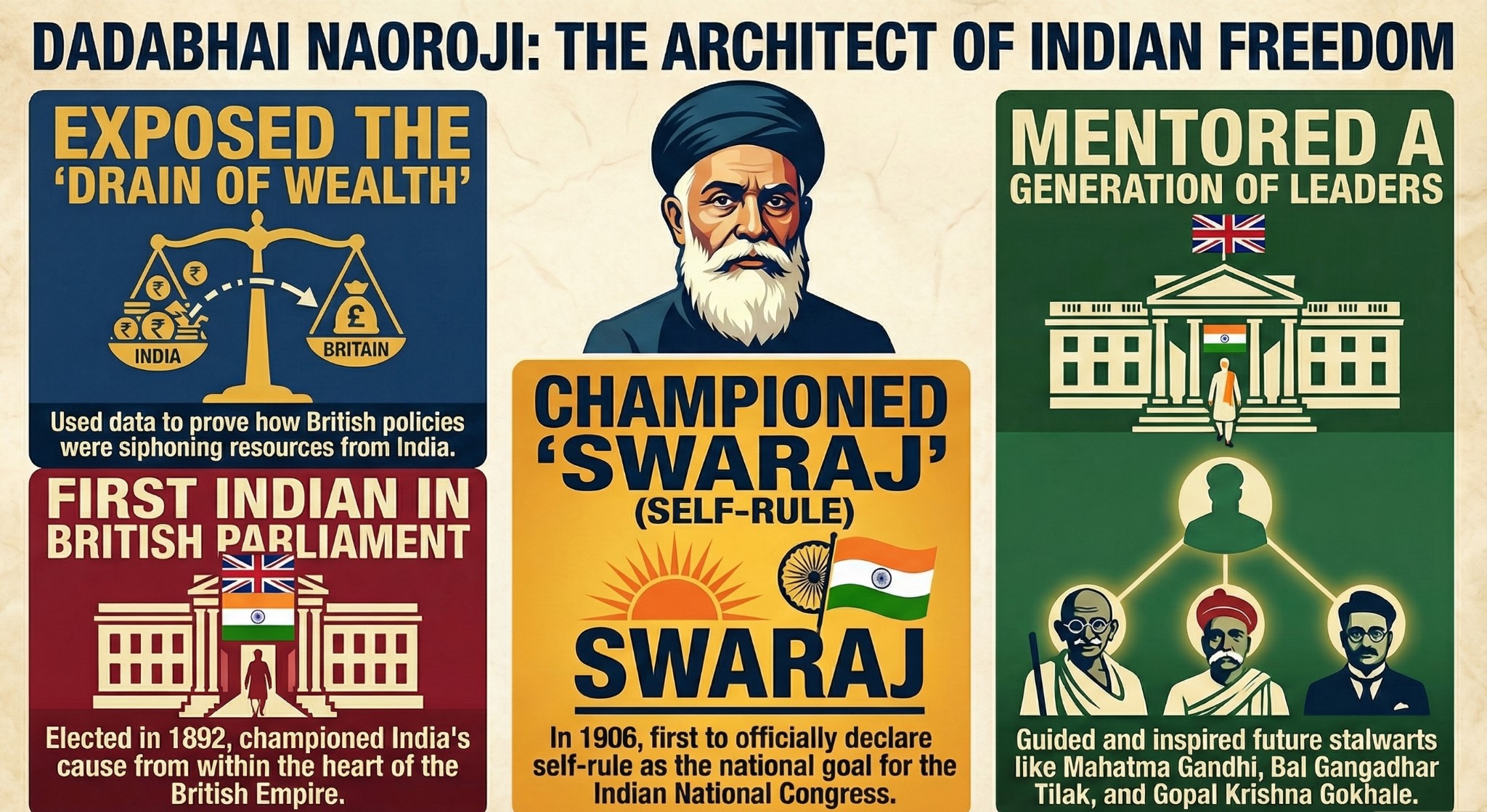
- The Theory: Naoroji systematically dismantled the colonial narrative by propounding the "Drain of Wealth" theory. He demonstrated how Britain was draining India’s resources through administrative salaries, pensions, remittances, and unequal trade practices.
- Key Works: Authored the seminal book Poverty and Un-British Rule in India and Poverty of India.
- Impact: His advocacy led to the establishment of the Welby Commission (1895) to investigate Indian expenditure. He served as a member of this commission, laying the intellectual foundation for Swadeshi and fiscal self-reliance.
Political Journey
- Parliamentary Pioneer: In 1892, he became the first Indian MP in the British House of Commons, elected from Central Finsbury on a Liberal Party ticket.
- Congress Leadership: A founding member of the Indian National Congress (INC), he served as its President three times (1886, 1893, and 1906).
- The Call for Swaraj: Presiding over the historic 1906 Calcutta Session, he was the first to officially adopt "Swaraj" (self-rule) as the national goal of the Congress.
- Unifying Figure: He acted as a bridge between the Moderates and Extremists and mentored future stalwarts like Gopal Krishna Gokhale, Bal Gangadhar Tilak, and Mahatma Gandhi.
Social & Institutional Reforms
- Social Reform: He was a staunch advocate for women's education and co-founded the Rahnumai Mazdayasan Sabha (1851) to reform the Parsi community.
- Journalism: Founded the Gujarati newspaper Rast Goftar ("The Truth Teller") to champion social progress.
- Education: Along with Jyotiba Phule, he submitted recommendations to the Hunter Commission (1882) advocating for compulsory primary education.
- Global Advocacy: Established the London Indian Society (1865) and the East India Association (1866) to internationalize Indian grievances and garner support in Britain.
Unique Facts
- Titles: Revered globally as the "Grand Old Man of India" and the "Unofficial Ambassador of India."
- Academic Firsts: He taught Gujarati at University College London, breaking early academic barriers for Indians abroad.
- Data-Driven: He was among the first to use statistical data to scientifically analyze and prove the extent of poverty in India.
Conclusion
Dadabhai Naoroji was not just a politician but the intellectual father of Indian nationalism. By exposing the economic exploitation of colonial rule and demanding self-government within constitutional frameworks, he prepared the ground upon which the struggle for India's independence was eventually fought and won.