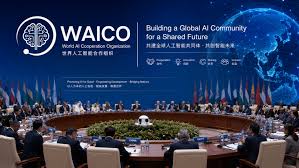
World Artificial Intelligence Cooperation Organisation
World Artificial Intelligence Cooperation Organisation
The global trajectory of artificial intelligence (AI) has arrived at a transformative inflection point. While rapid technological advancements promise to revolutionize industries, boost economic productivity, and reshape public services, they have simultaneously deepened the technological divide between advanced industrial economies and the Global South. In response to this growing imbalance, the launch of the World Artificial Intelligence Cooperation Organisation (WAICO) in Shanghai marks a significant institutional milestone in international technological diplomacy. Spearheaded by China and supported by an initial coalition of founding member nations, WAICO positions itself as a global platform dedicated to democratizing AI technology and formulating inclusive governance standards tailored to the needs of developing countries.
The official establishment of WAICO occurred on the sidelines of the World Artificial Intelligence Conference (WAIC) in Shanghai. Attended by high-ranking international dignitaries, including United Nations Secretary-General António Guterres, the signing ceremony signaled a concerted effort to move global AI policy discussions beyond the exclusive domains of Western technology hubs and proprietary corporate ecosystems. By creating a dedicated intergovernmental body centered on sovereign equality, shared progress, and capacity building, the coalition seeks to ensure that the transformative benefits of artificial intelligence are distributed equitably across the global community.
Architecture and Foundational Objectives
Headquartered in the global financial and technological hub of Shanghai, WAICO operates as an independent intergovernmental organization. Its foundational agreement explicitly commits to upholding the principles and purposes of the United Nations Charter. Unlike traditional regulatory bodies that prioritize restrictive oversight or values-based membership criteria, WAICO’s institutional design is anchored in extensive consultation, joint contribution, and shared benefits. Its core mandate centers on advancing human-centric AI development, fostering inclusive economic growth, and closing what international observers describe as the expanding "global intelligence gap".
The mandate of WAICO spans multiple dimensions, ranging from standard-setting and joint scientific research to policy alignment and cross-border digital infrastructure expansion. By creating an institutional forum where sovereign nations can engage as equal stakeholders, the organization aims to build a consensus-driven approach to AI oversight. This structure provides a formal mechanism for developing economies which have historically been sidelined in international standard-setting bodies to directly participate in drafting the rules, trade protocols, and ethical guidelines that will govern the future deployment of autonomous systems.
Empowering the Global South Through Capacity Building
A foundational pillar of WAICO’s vision is its explicit orientation toward the Global South. The organization’s initial membership reflects a broad geographical coalition across Asia, Africa, Eastern Europe, and Latin America, encompassing nations such as Indonesia, Kazakhstan, Brazil, South Africa, Pakistan, Russia, and Ethiopia. For many of these developing economies, the primary bottleneck in leveraging artificial intelligence lies not in a lack of ambition, but in severe constraints regarding computing infrastructure, technical expertise, and localized training data.
To address these structural deficiencies, WAICO has launched a comprehensive capacity-building framework. Central to this program is a commitment to provide 5,000 training opportunities, technical seminars, and research fellowships over the next five years aimed at upskilling engineers, researchers, and public policy officials from developing nations. Furthermore, WAICO is establishing dedicated AI application cooperation centers in partnership with major regional bodies, including the Association of Southeast Asian Nations (ASEAN), the African Union (AU), BRICS, the Shanghai Cooperation Organisation (SCO), the League of Arab States, and the Community of Latin American and Caribbean States (CELAC). These specialized hubs will serve as incubators for localized AI applications, facilitating technology transfer in crucial sectors such as agricultural optimization, healthcare diagnostics, disaster management, and public administration.
Open-Source Models as Tools for Global Collaboration
In contrast to the prevailing paradigm in Silicon Valley, where frontier AI models are largely closed, proprietary, and monetized through restrictive corporate architectures WAICO actively promotes an open-source development philosophy. By encouraging the dissemination of open-weight large language models and accessible algorithm frameworks, the organization seeks to convert advanced AI tools into global public goods. This strategy provides developing nations with viable, cost-effective alternatives to dominant Western platforms such as OpenAI’s ChatGPT and Anthropic’s Claude.
Open-source AI collaboration offers crucial strategic advantages for emerging economies. It enables local developers and domestic enterprises to inspect, fine-tune, and deploy models tailored to regional languages, cultural contexts, and unique economic needs without incurring prohibitive licensing fees or depending on foreign cloud providers. By facilitating widespread access to adaptable base models, WAICO aims to cultivate native AI ecosystems across member states. This approach reduces technological lock-in, encourages local entrepreneurial innovation, and ensures that sovereign nations retain control over their digital infrastructure and intellectual capital.
Redefining AI Governance and Digital Sovereignty
The emergence of WAICO introduces a distinct alternative to prevailing Western governance frameworks. Where Western initiatives often prioritize pre-deployment risk mitigation, strict safety guardrails, and values-based political criteria, WAICO champions an approach centered on digital sovereignty, economic development, and non-interference. The organization firmly advocates that every nation possesses the sovereign right to govern its domestic digital sphere, regulate data flows, and develop AI capabilities in accordance with its national priorities and political systems.
Simultaneously, WAICO’s charter challenges the unilateral imposition of export controls and technology blockades. Member nations voice strong opposition to overstretching national security concepts to restrict foreign access to advanced semiconductors, cloud computing resources, and software tools. However, this emphasis on open access does not equate to an absence of regulation. WAICO explicitly advocates for robust, adaptive safety protocols, including traceable data standards, boundary definitions for autonomous AI agents, and early-warning mechanisms designed to prevent "loss-of-control" scenarios, ensuring that rapid technological advancement remains controllable, secure, and beneficial to society.
Geopolitical Implications and the Emerging Dual-Pole Tech Order
The creation of WAICO underscores a profound shift toward a multi-polar or dual-pole architecture in global technology governance. On one side stands the United States-led framework, supported by initiatives such as "Pax Silica" and the "AI Opportunity Statement," which emphasize trusted supply chains, advanced chip manufacturing controls, and closed-loop proprietary systems. On the other side, WAICO offers a sovereign-centric, development-first alternative backed by Chinese hardware manufacturing, open-source software, and institutional capacity building.
For China, leading WAICO elevates its stature from a dominant producer of competitive AI applications to a primary architect of global technical standards and normative frameworks. For member states across the Global South, the organisation provides crucial leverage. Rather than remaining passive consumers in an ecosystem controlled by a handful of multinational technology conglomerates, developing nations gain a collective voice to shape global policies on data governance, intellectual property, and infrastructure funding.
Conclusion: Toward an Inclusive Digital Era
The launch of the World Artificial Intelligence Cooperation Organisation in Shanghai represents a defining moment in the evolution of international technological cooperation. By marrying open-source innovation with robust capacity building and a steadfast commitment to digital sovereignty, WAICO offers a compelling governance model for nations seeking to participate in the ongoing AI revolution without compromising their autonomy.
As artificial intelligence continues to reshape the global economic, social, and political landscape, the success of institutions like WAICO will depend on their ability to bridge ideological divides and deliver tangible technical benefits. By prioritizing inclusivity, mutual learning, and shared prosperity over geopolitical friction, WAICO has laid the groundwork for a more equitable digital future—one where advanced artificial intelligence serves as a universal tool for human progress rather than a driver of global inequality.